The true measure of a luxury garment is rarely announced by a logo; it is whispered through the precision of its construction. In the realm of men’s and women’s shirting, perhaps no garment is as ruthlessly exposing of poor manufacturing as the linen shirt. Often associated with the relaxed elegance of “Quiet Luxury,” a premium linen shirt must perform a difficult balancing act: it must be inherently casual and breathable, yet possess enough structural integrity to look undeniably sophisticated.
For the discerning buyer or the sartorial enthusiast looking beyond brand names, evaluating a high-end linen shirt requires an understanding of textile engineering and traditional tailoring. Here is the definitive guide to assessing the true quality of a linen shirt, focusing on the holy trinity of garment construction: the drape of the fabric, the “bone” of the collar, and the density of the stitching.
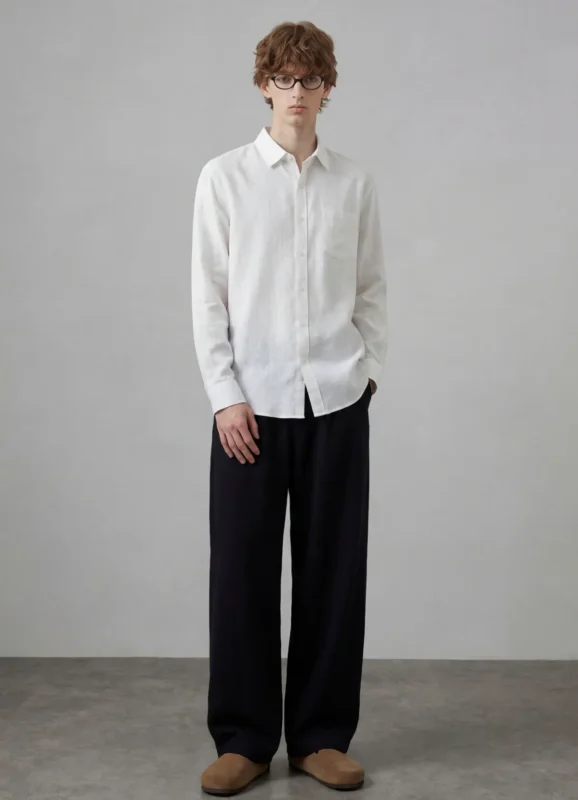
The vast majority of mass-produced linen feels dry, scratchy, and stiff. This is a hallmark of aggressive industrial processing and poor yarn tension control. When evaluating the fabric drape of a premium linen shirt, you are looking for a liquid, almost fluid weight that skims the body rather than standing away from it in rigid angles.
Yarn Tension and Weaving The secret to exceptional drape begins at the loom. In high-volume manufacturing, weaving machines are run at maximum speeds, requiring high yarn tension to prevent breakage. This high tension results in a tight, stiff fabric that resists the natural movement of the body. Luxury shirting, conversely, utilizes looms running at slower speeds with meticulously calibrated, lower yarn tension. This preserves the natural elasticity and softness of the Normandy flax fibers, resulting in a fabric that breathes better and drapes with a heavy, elegant languor.
Finishing Processes You cannot evaluate fabric quality without considering the wash and finish. Top-tier linen shirts undergo specialized treatments to eliminate the “break-in” period entirely. Techniques such as enzyme washing or an Aloe Vera finish soften the flax fibers on a microscopic level without compromising their tensile strength. When you touch the fabric, it should feel cool, unexpectedly soft, and possess a subtle, natural luster—never abrasive. Furthermore, premium manufacturers rigorously pre-shrink their fabrics. If a linen shirt shrinks more than 1-2% after its first cold wash, the supply chain has cut corners on the fabric finishing stage.
The collar is the anchor of any shirt; it frames the face and dictates the formality of the entire outfit. In the context of a luxury linen shirt—especially those aiming for the effortless Mediterranean aesthetic—the collar must achieve a state of relaxed structure. It should stand up proudly under a tailored jacket but roll beautifully when left unbuttoned.
The Interlining Strategy Mass-market shirts utilize cheap, stiff, fusible interlinings (glue pressed into the collar) that bubble after a few washes and create a rigid, unnatural look. A high-quality linen shirt uses floating interlinings, often made from a lighter-weight linen or fine cotton canvas. This internal structure is the “bone” of the collar. It provides a three-dimensional memory to the fabric, allowing it to curve and roll rather than fold flat and crease.
The One-Piece Collar (The André Style) The ultimate test of shirting craftsmanship is the one-piece collar, where the collar band and the collar leaf are cut from a single continuous piece of fabric. Because there is no seam connecting the band to the collar, the fabric must be masterfully cut on the bias (the diagonal of the weave) to achieve the perfect outward roll. When inspecting a high-end linen shirt, look at how the collar opens at the neck. It should create a graceful, unbroken curve sweeping from the collarbone down to the sternum. If the collar collapses flat against the chest, it lacks the proper architectural “bone.”
While the fabric and collar are immediately visible, the stitching is the true lie-detector of garment manufacturing. It dictates the longevity of the shirt and the refinement of its seams.
Stitches Per Inch (SPI) The standard metric for sewing quality is SPI. Fast-fashion garments typically feature 10 to 14 stitches per inch. High-end luxury tailoring demands a minimum of 18 to 22 SPI. This ultra-high density stitching requires sophisticated sewing machines operated at slower speeds by highly skilled machinists, as fine needles can easily break, or the thread can snap if not handled perfectly. High SPI results in a seam that is incredibly strong, lays perfectly flat, and looks like a continuous, elegant line rather than a series of dots.
Single-Needle French Seams Turn the shirt inside out and inspect the side seams and the armholes. Lower-tier shirts use an overlock stitch (serging), which leaves a bulky, exposed matrix of threads on the interior. A premium linen shirt utilizes single-needle tailoring and French seams. This means the raw edges of the fabric are folded in on themselves and sewn shut, leaving a clean, narrow, and entirely enclosed seam on both the inside and outside of the garment. This not only looks beautiful but prevents the linen from fraying over time and ensures nothing scratches against the skin.
Hardware and Placket Alignment Finally, examine the finishing touches. The buttons should be genuine Mother of Pearl (ideally Pinctada Maxima shells), identifiable by their cool touch and iridescent backing, measuring at least 2mm to 3mm in thickness. They should be sewn on with a shank (a thread wrapped around the base) to allow the button to sit comfortably through the buttonhole without pulling the fabric. Additionally, inspect the front placket and pocket (if applicable) for pattern matching; the vertical grain of the linen should align perfectly uninterrupted.
True luxury in a linen shirt is not an abstract concept; it is an accumulation of deliberate, costly manufacturing decisions. It is the calibration of yarn tension on the loom, the bias cut of a floating collar, and the slow, deliberate work of single-needle stitching.
When you evaluate a garment through this lens, the price tag of high-end shirting begins to make sense, not as a markup for a brand name, but as the actual cost of uncompromising craftsmanship. By understanding the mechanics of drape, bone, and stitching, you empower yourself to look beyond the label and invest in garments that offer intrinsic, enduring value.
 EN EN
EN EN  ES
ES
 FR
FR
 DE
DE