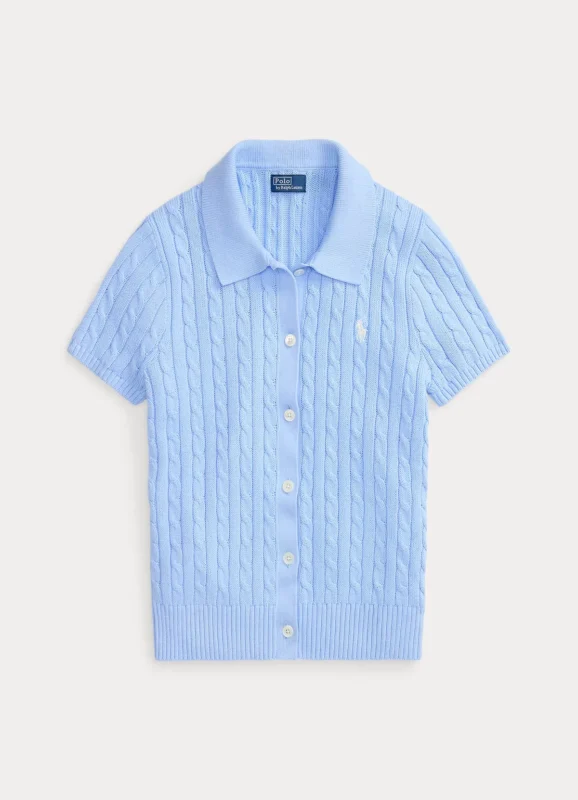
The Ralph Lauren polo shirt is arguably the most ubiquitous garment in modern menswear. Because of its cultural dominance, it is also one of the most replicated. For decades, a clandestine arms race has existed between counterfeit manufacturers and authenticators. While illicit factories have managed to source identical piqué cotton, clone the QR code wash tags, and duplicate the precise dimensions of the “Custom Slim Fit,” they consistently fail at one critical juncture: the left chest.
To the untrained eye, a counterfeit polo player looks “close enough.” But to a garment technologist or a seasoned authenticator, the Ralph Lauren pony logo is a cryptographic signature. It is not merely a picture sewn onto fabric; it is a masterclass in microscopic thread tension, digital pathing, and spatial geometry. Here is the anatomical breakdown of why the Ralph Lauren Polo embroidery remains an impossible benchmark for counterfeiters to perfect.
Embroidery is not a two-dimensional print; it is a three-dimensional sculpture made of thread. The creation of the pony logo begins with a “digitizing path”—the exact sequence of movements the needle takes to build the design.
Counterfeiters simply scan a photograph of the logo and use automated software to generate a stitch path. This results in a flat, lifeless shape. Ralph Lauren’s digitized path is a highly guarded, proprietary sequence. Before the visible outer layer (the satin stitch) is applied, the machine lays down an intricate underlay. This invisible foundation of thread gives the horse and rider their distinct, three-dimensional volume. It supports the top stitches, preventing them from sinking into the textured piqué cotton. Without this precise, multi-layered digital DNA, counterfeit ponies look emaciated, flat, or lack the characteristic “lift” off the fabric.
When evaluating Ralph Lauren polo embroidery, you must examine the logo as a collection of distinct anatomical parts. Authentic embroidery utilizes varying stitch directions to catch the light differently, creating the illusion of muscle tone and movement. Counterfeiters, aiming for speed and mass production, merge these elements into a single, continuous blob of thread.
The polo mallet is the most notorious trap for counterfeiters. On an authentic shirt, the mallet must be perfectly straight, held securely by the rider’s distinctly visible right arm. There must be a clear, microscopic gap of un-embroidered fabric between the rider’s head, his raised arm, and the mallet itself. Fakes routinely fail here; the mallet often looks curved like a fishing pole, or it merges entirely with the rider’s head into a solid mass.
Look closely at the space between the rider’s hands and the horse’s neck. You should clearly see the reins acting as a distinct, thin line of tension. The rider himself is not a shapeless silhouette; you can identify the definition of his torso leaning forward, and his back leg gripping the saddle. The helmet has a distinct shape, often with a microscopic visor visible depending on the era of the shirt.
An authentic pony has four distinct, highly articulated legs. The hooves are clearly defined, and the tail is separated from the left hind leg. In counterfeit versions, the two front legs often blur into one thick appendage, or the tail is merged with the back leg to save sewing time and reduce thread trimming. Furthermore, the ears of the horse must point distinctly forward and upward, signaling motion—a detail lost when cheap embroidery machines lack the needle calibration to render a single, precise stitch.
The canvas matters just as much as the paint. Ralph Lauren polo shirts are famously crafted from piqué cotton—a knit fabric characterized by its breathable, waffle-like texture. Embroidering a dense, 1,000+ stitch logo onto a stretchy knit fabric without causing the fabric to warp is a severe mechanical challenge.
This is a phenomenon known as “push and pull” in embroidery. When a needle repeatedly punctures fabric and pulls thread tight, the fabric naturally wants to bunch up. Ralph Lauren’s manufacturing facilities utilize high-end, heavily calibrated machines (often from brands like Tajima or Barudan) with perfectly tensioned bobbin threads to prevent this.
When you look at an authentic pony, the piqué cotton immediately surrounding the logo is perfectly flat. On counterfeits, you will almost always see “puckering”—a permanent, wrinkled halo around the embroidery where the cheap machine’s high-tension thread has irreversibly warped the knit.
To compensate for poor machine calibration, counterfeiters use heavy, stiff chemical stabilizers on the back of the logo to prevent puckering. If you touch the embroidered chest of a fake polo, it often feels like a stiff piece of cardboard has been glued inside the shirt. An authentic polo uses a high-grade, easily tearable backing that softens immediately after the first wash, leaving the chest pliable and comfortable against the skin.
If the front of the embroidery is the performance, the back of the embroidery is the backstage. Turning the shirt inside out reveals the naked truth of the manufacturing process.
An authentic Ralph Lauren logo maintains its distinct shape even in reverse. You will see a clean, predominantly white (or tonal) bobbin thread outline locking the colored top thread into place. More importantly, there will be virtually no jump stitches—the messy, loose threads connecting different parts of the design. High-end machines are programmed to automatically trim the thread between the horse’s tail and the rider’s mallet. Counterfeit factories disable the auto-trim function to save a few seconds of production time per shirt, resulting in a chaotic “spiderweb” of loose threads connecting the head, legs, and mallet on the inside of the garment.
Ultimately, the reason the Ralph Lauren pony cannot be perfectly replicated is a matter of basic economics. Achieving this level of micro-embroidery requires slow machine speeds, frequent needle replacements, high-tensile strength threads, and rigorous quality control protocols that reject any garment with a single dropped stitch.
Counterfeit manufacturing is built entirely on speed and cost reduction. They can steal the pattern, and they can source the fabric, but they cannot afford the time and mechanical precision required to sculpt the pony. By understanding the anatomy of this iconic logo, you elevate yourself from a casual consumer to an informed authenticator, capable of seeing the invisible engineering that defines true sartorial quality.
 EN EN
EN EN  ES
ES
 FR
FR
 DE
DE