
When dissecting the modern gentleman’s wardrobe, true luxury is rarely found in the loudest pieces. It is found in the quiet, structural perfection of the fundamentals. For the affluent male demographic, no garment represents this better than the premium summer linen shirt. If you look closely at the highest echelons of “Quiet Luxury”—specifically the benchmark set by the classic Loro Piana shirt men gravitate toward for yachting or resort wear—you will notice a distinct architectural feature: the collar.
It does not stand stiffly like a corporate dress shirt, nor does it collapse limply like a cheap fast-fashion polo. It flows. It rolls. It is a masterpiece of sartorial engineering known as the one-piece collar (or the seamless collar).
To the untrained eye, it looks effortlessly relaxed. To anyone involved in high-end apparel supply chains, it is a notoriously difficult construction that separates premium ateliers from volume-driven sweatshops. Here is a definitive breakdown of why ordinary garment factories consistently fail to execute this crucial detail, and why true “Old Money” texture requires uncompromising manufacturing discipline.
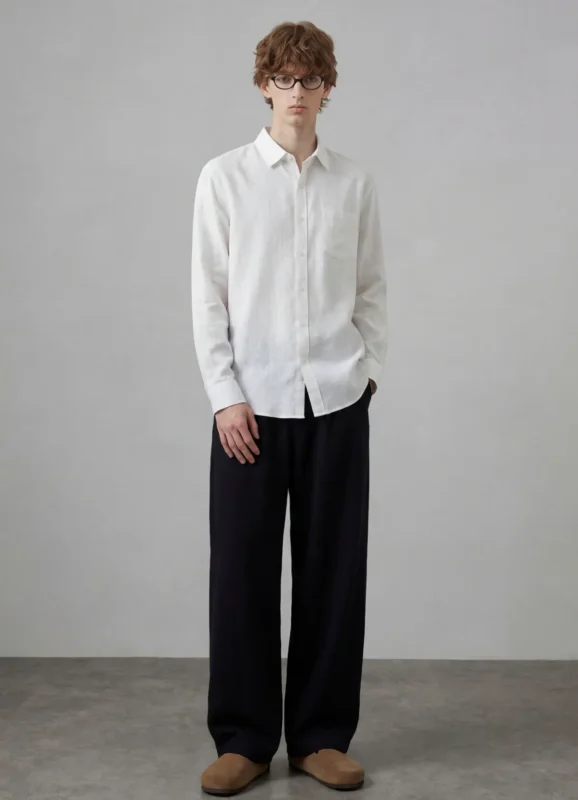
To understand the failure, one must first understand the design. A traditional dress shirt collar is constructed in distinct parts: the collar leaf (the part you see), the collar band (the piece wrapping around the neck), and the placket (where the buttons live). These pieces are sewn together and reinforced with a stiff, glued interlining.
The one-piece collar, famously utilized in elite models like the Loro Piana André, eliminates the collar band entirely. The fabric of the front placket extends seamlessly upward, curving around the neck to become the collar itself.
Because there is no artificial stiffening and no dividing seam to force the fabric to stand up, the collar relies entirely on the precise geometry of the cut and the natural weight of the fabric to maintain its shape. When left unbuttoned, it creates a perfect, elegant “roll” that frames the face—the ultimate symbol of relaxed affluence.
Why can’t a standard factory simply copy the pattern and produce the same shirt? The answer lies in the harsh realities of mass-production physics and quality control.
Ordinary factories optimize for one metric: fabric yield. To save money, patterns are laid out strictly along the straight grain of the fabric.
A proper one-piece collar cannot be cut on the straight grain. To achieve that signature, sweeping roll without buckling, the fabric must be cut on the bias (a 45-degree angle to the weave). Cutting on the bias allows the woven linen to stretch and mold naturally around the three-dimensional curve of the human neck. However, cutting on the bias consumes significantly more fabric and creates massive textile waste. Mass-market factories fundamentally reject this geometry because it destroys their profit margins.
Sewing a straight line is a basic skill; sewing a seamless curve on bias-cut linen without creating micro-puckers requires exceptional mastery.
When the front placket transitions into the collar, the sewing operator must manipulate the fabric tension by hand, millimeter by millimeter, feeding it through the machine at a highly specific rhythm. Mastering this specific tactile feedback is not a matter of simply upgrading machinery; it requires a workforce that has spent over a decade—often 11 to 15 years—perfecting their craft on premium textiles. In factories burdened by high turnover and quota-based piece-rate pay, workers simply do not have the time or the specialized training to execute this curve. The result is a collar that pulls, twists, and looks incredibly cheap the moment it leaves the pressing board.
The “effortless” look requires the highest degree of effort behind the scenes. Ordinary factories rely on a basic end-of-line inspection—checking for loose threads or missing buttons.
Executing a flawless one-piece collar demands a zero-tolerance environment. It requires something closer to a 28-step quality control protocol, where every variable is scrutinized: the tension of the yarn, the exact millimeter of the seam allowance, the alignment of the buttonholes, and the stability of the fabric after its initial wash. If step number seven is slightly off, the collar will not roll correctly at step twenty-eight. High-end manufacturing hubs treat this process as an interconnected ecosystem, while standard factories treat it as an assembly line.
Even if a standard factory managed to copy the exact sewing technique, they would still fail at the sourcing level. The one-piece collar demands a fabric with a very specific structural integrity.
Standard, coarse linen will simply fold flat and crease like paper when subjected to this collar design. The reason the ideal loro piana shirt men invest in looks so pristine is due to proprietary fabric treatments—such as aloe vera immersion—that soften the microscopic edges of the flax fibers while adding a distinct, heavy drape. The fabric must be substantial enough to support its own weight without the crutch of a stiff interlining.
Furthermore, premium supply chains execute rigorous shrinkage control before the garment is sewn. If an ordinary factory uses untreated linen, the bias-cut collar will warp dramatically after the consumer’s first wash, entirely destroying the carefully engineered roll.
When a man invests in a meticulously crafted linen shirt with a one-piece collar, he is not paying for a logo. He is paying for the rejection of compromises.
He is paying for the extra fabric consumed by the bias cut. He is paying for the highly skilled artisan who slowed down their sewing machine to ensure the tension was flawless. He is paying for an exhaustive quality control regime that refused to let a slightly puckered seam hit the retail floor.
The next time you see a seemingly simple linen shirt perfectly framing a man’s collarbone with a soft, elegant roll, understand that it is not an accident of styling. It is the result of a highly disciplined, sophisticated manufacturing process that ordinary factories simply do not have the patience, the skill, or the mandate to achieve.
 EN EN
EN EN  ES
ES
 FR
FR
 DE
DE