To the untrained eye, the appeal of luxury fashion often begins and ends with a logo. When discussing the cultural dominance of Prada shirts, casual consumers point to the enameled metal triangle on the chest pocket as the primary driver of value. However, garment technologists, seasoned tailors, and luxury supply chain experts understand a different reality: true luxury is engineered on the factory floor, not in the marketing department.
Stripping away the brand insignia reveals a masterclass in textile science and spatial geometry. The true value of premium Prada shirts lies deep within their structural DNA—from the calibration of the sewing machines to the microscopic tension of the yarn. If you want to understand why these garments command their price point, and why their distinct silhouette is so notoriously difficult to replicate, you must look inside the seams.
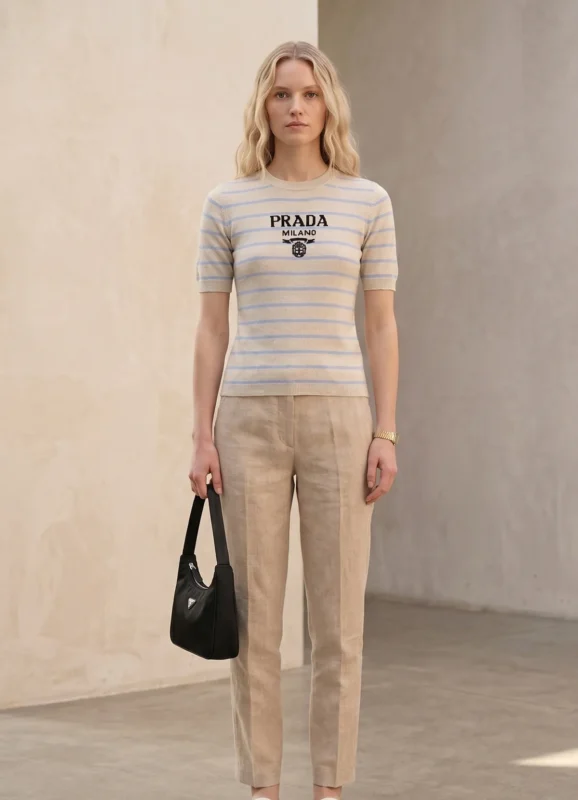
The most defining characteristic of modern Prada shirting is its specific spatial relationship with the body. Whether examining a camp-collar bowling shirt or a traditional button-down, the garment never simply hangs; it maintains a deliberate, architectural shape.
Many fast-fashion brands attempt to replicate the “boxy fit” by simply scaling up a standard shirt block—essentially making the garment wider. This results in a sloppy, unstructured drape. Prada achieves its signature structured volume through rigorous pattern manipulation. The armhole (armscye) is dropped slightly to create a relaxed profile, but the sleeve cap is simultaneously flattened. This allows the fabric to fall squarely from the shoulder without pooling excessively at the underarm, maintaining a clean, geometric line that flatters the torso while offering complete mobility.
A collar determines the framing of the face, acting as the foundation of a shirt’s aesthetic. In premium Prada shirts, collars are never entirely flat or rigidly stiff. They utilize precisely cut, high-grade fusible or sewn-in interfacing layered specifically at the collar points and the band. This creates a natural, elegant “roll”—a continuous curve that holds its shape under the collarbone without buckling throughout the day.
The structural integrity of any garment dictates its tailoring potential. Prada’s fabric sourcing relies on mills that prioritize structural memory and yarn performance over sheer softness.
When evaluating the brand’s traditional dress and casual shirts, the cotton poplin utilized is an exercise in high-tension weaving. Prada typically employs high-twist, two-ply cotton yarns, often woven from extra-long-staple fibers.
The two-ply construction (twisting two microscopic yarns into a single, stronger thread before weaving) yields a fabric that is incredibly dense yet lightweight. More importantly, the high-twist nature of the yarn gives the poplin exceptional “fabric memory.” When you pinch the fabric, it possesses a distinct, springy resilience. It resists turning into a mushy, lifeless wrinkle, maintaining the crisp, architectural drape necessary to support the shirt’s geometric pattern.
Prada’s proprietary technical material, Re-Nylon, represents a triumph in synthetic manipulation. Lower-tier manufacturers utilizing standard polyester or commercial nylon produce garments with an artificial, highly reflective sheen and an inherent static cling. Prada’s technical fabric undergoes specialized mechanical and chemical finishing processes that yield a matte-yet-lustrous surface. It is engineered with a specific specific gravity—meaning the fabric carries enough microscopic weight to drape cleanly downwards, rather than ballooning outward or clinging aggressively to the body.
The most glaring differentiator between a premium luxury garment and a standard commercial piece is stitch execution. This is where the invisible cost of luxury manufacturing is accumulated.
In garment manufacturing, quality is quantified by Stitches Per Inch (SPI). Standard mall-brand shirts are sewn at roughly 10 to 12 SPI to maximize machine speed and reduce labor costs. Premium Prada shirts are consistently sewn at an exacting 18 to 22 SPI.
This high-density stitching requires ultra-fine needles (often size 60/8 or 70/10) to prevent fabric puckering, and the machine operators must run their equipment at slower speeds to maintain precision. The resulting seam is visually seamless, appearing as a continuous line of fine thread. Structurally, the increased number of stitches distributes physical tension evenly across the seam, making the garment exponentially more durable against tearing or seam slippage.
Luxury dictates that functional elements must also be flawless. The buttonholes on these shirts are cut before they are finished with a high-density purl stitch. This locks the raw edges of the fabric securely and creates a raised, rigid border that will not fray over a lifetime of use. Furthermore, buttons—whether bespoke tonal snap closures or thick mother-of-pearl—are attached with a distinct thread shank. This invisible pillar of thread elevates the button slightly above the fabric, allowing the opposing placket to slide underneath perfectly without distorting the shape of the shirt front.
The ultimate test of a garment’s pedigree is conducted by turning it inside out. Brands that cut corners focus their budget on exterior aesthetics, leaving the internal construction raw, bulky, or finished with a basic overlock stitch (serging).
Examine the side seams and armhole joints of premium Prada shirts. You will routinely find immaculate French seams. A French seam folds the raw edges of the fabric inward, enclosing them completely within a secondary line of stitching. This requires twice the amount of sewing time and a highly skilled machinist to keep the seam allowance incredibly narrow—often under 5 millimeters. The result is a perfectly flat, clean interior that sits flush against the skin, eliminating chafing and ensuring the fabric’s external drape is never interrupted by internal bulk.
Evaluating Prada shirts through the lens of supply chain mechanics and tailoring techniques fundamentally shifts how one perceives garment value. The retail price is not merely a toll paid for a designer name; it is an investment in uncompromising construction standards. From the microscopic twist of the poplin yarn to the labor-intensive execution of 20 SPI French seams, every element is deliberately calculated to construct a garment that defies standard manufacturing limitations. True luxury is quiet; it is the absolute confidence of a garment that is finished just as flawlessly on the inside as it is on the outside.
 EN EN
EN EN  ES
ES
 FR
FR
 DE
DE