
In the highest echelons of luxury apparel, the absence of a logo is often the loudest statement of wealth. To the untrained eye, a minimalist, monochromatic shirt may appear indistinguishable from a mass-market alternative. Yet, the retail price often exceeds a thousand dollars. This pricing paradox is perfectly encapsulated by brunello cucinelli shirts.
Operating from the medieval hamlet of Solomeo, Italy, the brand has become the undisputed sovereign of “Quiet Luxury.” But the astronomical price point is not merely a byproduct of brilliant marketing or an artificial markup. From a strict supply chain and garment engineering perspective, the cost is justified by uncompromising manufacturing tolerances that are practically impossible for standard factories to replicate. If you want to understand true luxury, you must look past the silhouette and examine the structural execution. Here is an insider’s deconstruction of the three invisible manufacturing barriers that justify the peak pricing of these iconic garments.
The foundation of any high-end garment is the raw material, but Brunello Cucinelli operates on a tier of textile sourcing that most manufacturers cannot access. The barrier here is not just buying “good cotton” or “pure silk”; it is the rigorous pre-selection and pre-treatment processes that occur before a single pattern is cut.
Exclusive Fiber Sourcing: Mass-market premium brands might boast of using long-staple cotton. Brunello Cucinelli, however, secures the absolute top percentile of global yields, such as the finest Sea Island cotton or exclusive blends of cashmere and silk. These fibers possess a microscopic uniformity. When spun into high-count, double-twisted yarns (often exceeding 170-count), the resulting fabric feels incredibly dense yet weightless. It possesses a natural, matte luster that synthetic or lower-tier natural fibers can never achieve.
Zero-Tolerance Pre-Shrinking: A critical flaw in standard shirt manufacturing is dimensional instability. When a factory prioritizes speed, raw fabric is cut and sewn immediately. After the consumer washes it, the warp and weft yarns contract, leading to micro-shrinkage. This is why standard shirts develop warped collars and puckered side seams over time.
The manufacturing standard for Brunello Cucinelli dictates that all fabrics undergo exhaustive, high-cost pre-washing and stabilization protocols. The fabric is subjected to the exact moisture and heat conditions it will experience in its lifespan, locking its dimensions in place. The shirt you buy is structurally finalized; it will not shift, shrink, or warp by a single millimeter, ensuring decades of perfect drape.
The second invisible barrier is the rejection of absolute industrial automation in favor of highly skilled, time-intensive human labor. While a modern factory can output thousands of shirts a day utilizing high-speed sewing machines, brunello cucinelli shirts rely heavily on manual sartorial techniques, specifically in high-stress structural zones.
The Sartorial Armhole (Spalla Camicia): The most complex part of engineering a shirt is the armhole (the scye). In standard manufacturing, the sleeve and the body are stitched together in a straight, flat line by a machine. This creates a rigid seam. When you lift your arm, the entire body of the shirt pulls upward.
Cucinelli utilizes a traditional Neapolitan tailoring technique. The sleeve head is cut slightly larger than the armhole itself. A master artisan then hand-stitches the sleeve into the body, meticulously distributing the excess fabric (the “ease”) through microscopic gathers. This hand-sewn seam possesses a natural elasticity that a machine cannot replicate. It allows the wearer complete freedom of movement in the arms while the chest and torso of the shirt remain perfectly flat and elegantly draped.
Micro-Stitching Density: Where machines are used, the calibration is pushed to the limit. The industry standard for premium shirts is roughly 14 to 16 Stitches Per Inch (SPI). Cucinelli frequently pushes this density to 22 SPI or higher. This requires the sewing machines to operate at a fraction of their normal speed, drastically reducing factory yield rates. The result is a seam that is practically invisible, incredibly strong, and entirely free of the bulk that ruins the fluid lines of a luxury garment.
The final barrier lies in the finishing details. In luxury apparel, hardware and embellishments are never afterthoughts; they are critical components that must integrate flawlessly with the delicate base fabrics.
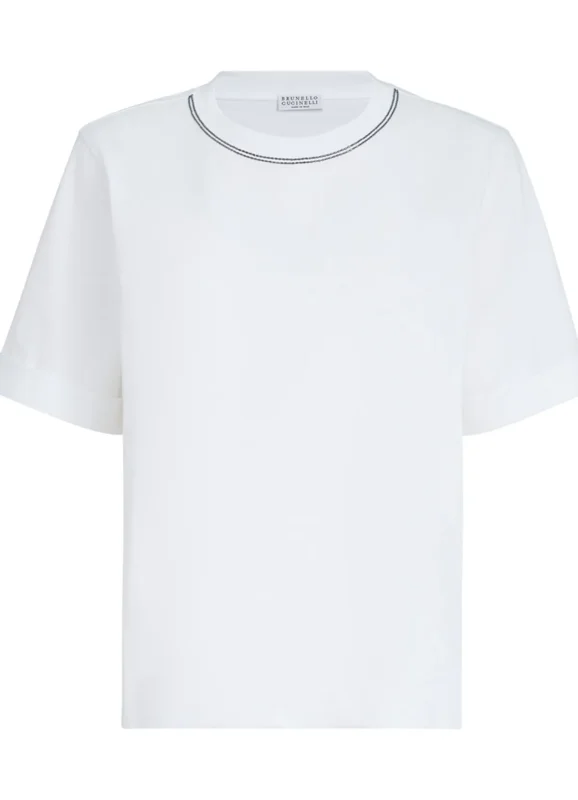
The Monili Bead Application: For womenswear, the brand’s signature is the Monili—tiny, multi-faceted brass beads that add a subtle, metallic brilliance to collars or cuffs. The engineering challenge here is immense: how do you attach heavy brass to whisper-thin silk or linen without distorting the fabric? It requires a proprietary, highly guarded application process. The tension of the thread holding the beads must be perfectly calibrated by artisans to match the exact “give” of the fabric. It results in a fluid, flexible band of metal that drapes just as softly as the silk beneath it, never once snagging or puckering.
Mother-of-Pearl and the Thread Shank: For classic button-downs, the brand utilizes the thickest, highest-grade Mother-of-Pearl (often sourced from the Troca shell). These buttons are not merely sewn flat against the placket. Artisans employ a hand-wrapped thread “shank”—winding the thread around the base of the button to elevate it slightly from the fabric. This microscopic elevation provides the exact physical space needed for the buttonhole side of the shirt to rest underneath it without pulling or stressing the fabric. Furthermore, the buttonholes themselves are densely bound with high-tensile silk thread, ensuring they never fray, stretch, or lose their precise rectangular shape.
Understanding the pricing of brunello cucinelli shirts requires a paradigm shift. You are not paying for a logo, a trendy silhouette, or a celebrity endorsement. You are paying for the sheer, uncompromising reality of high-end garment manufacturing.
True luxury is defined by the refusal to cut corners. It is the cost of monopolizing the world’s finest raw materials, the financial burden of slowing down machines to achieve microscopic stitch counts, and the dedication to hand-sewn architectures that prioritize human movement over factory efficiency. These three invisible barriers create a moat around the brand. It is an echelon of craftsmanship that can be admired, studied, and worn, but practically impossible to replicate without adopting the exact same rigorous, high-cost supply chain.


 EN EN
EN EN  ES
ES
 FR
FR
 DE
DE