The “Chanel-style” cardigan has become a ubiquitous silhouette in modern womenswear. From fast-fashion racks to contemporary designer collections, the contrasting trim and textured body are instantly recognizable. However, visual mimicry is easy; structural replication is not. To the untrained eye, any textured, collarless sweater might pass the aesthetic test. But for those who understand garment construction, the difference between a mass-market imitation and a genuine Chanel knit lies in a rigid set of textile engineering principles.
True “Quiet Luxury” is rarely about the logo. It is defined by the dimensional stability of the weave, the tactile complexity of the yarn, and the architectural precision of the finish. This guide deconstructs the manufacturing realities behind the world’s most iconic knitwear, providing an industry-grade breakdown of what separates premium textile craftsmanship from superficial fast fashion.
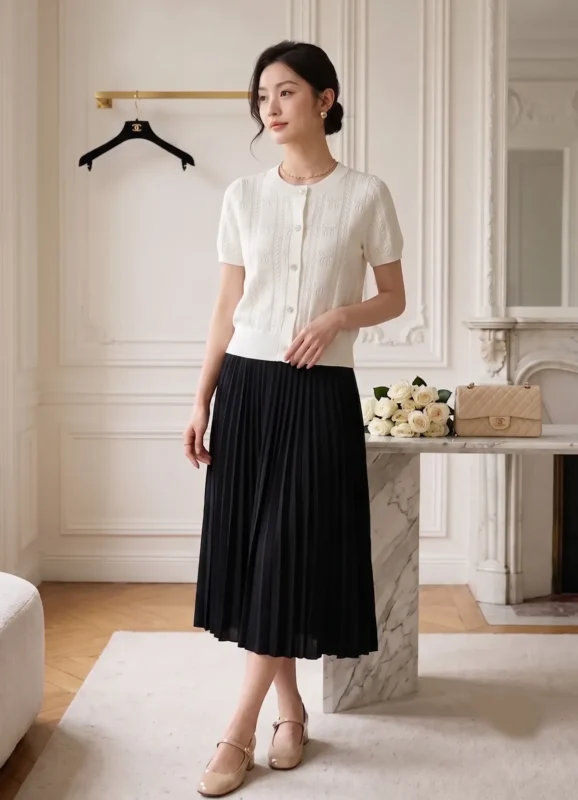
The defining characteristic of the classic Chanel knit is its heavily textured, multi-dimensional surface. This is predominantly achieved through the use of bouclé yarn. Derived from the French word for “curled” or “ringed,” bouclé features small loops of spun fiber projecting from the main thread.
The critical distinction between high-end manufacturing and budget production lies in the yarn composition and the blending process.
Mass-market brands achieve the textured look by utilizing 100% synthetic yarns—primarily acrylic and polyester. While these fibers mimic the initial fluffiness of a luxury knit, they possess zero memory and poor tensile strength. Within a few wears, synthetic loops flatten out, pill aggressively due to friction, and cause the garment to lose its intended shape. Furthermore, these synthetic fibers trap heat without breathing, ruining the wearing experience.
A high-caliber knit relies on a sophisticated composite of natural fibers. Creating a luxury bouclé effect often requires feeding up to six to eight distinct yarns into the knitting machine simultaneously.
The genius of the Chanel knit is its paradox: it offers the relaxed comfort of a sweater but commands the tailored authority of a structured jacket. Achieving this requires precise control over the knitting machine’s tension and gauge.
Cheap cardigans utilize a low-density, loose knit (low gauge) to save on raw material costs and speed up production. The result is a flimsy, drafty garment that stretches out at the elbows and sags at the hem.
A premium knit acts as a wearable architecture. It employs a high-density, tightly tensioned weave. The yarn is packed closely together, creating a substantial fabric weight (often referred to as “supple heft”). This high tension restricts the horizontal stretch of the fabric. When you pull gently on the side seams of a high-end knit, it should exhibit a firm resistance and snap back immediately to its original dimensions.
| Feature | Mass-Market Knit | Premium “Chanel-Style” Knit |
| Fabric Weight | Lightweight, prone to severe draping. | Substantial, holds its own shape when laid flat. |
| Stretch Recovery | Poor. Elbows bag out after one wear. | Excellent. High-density weave restricts warp distortion. |
| Yarn Blending | Single-feed synthetic bouclé. | Multi-feed composite (wool, silk, metallic threads). |
| Tactile Sensation | Scratchy or unnaturally slick. | Dry, complex, yet soft against the skin. |
The most vulnerable points of any knit garment are the seams and the edges. The contrasting trim on a Chanel knit is not merely a decorative choice; it serves a crucial structural function.
In lower-tier manufacturing, the contrasting edge is often just a separate piece of ribbon or cheap fabric machine-stitched onto the raw edge of the sweater. This causes puckering and uneven tension over time, as the ribbon and the sweater stretch at different rates.
In high-end manufacturing, the trim is typically a custom-woven braid (known as a galon). More importantly, this trim is often hand-linked or integrated directly into the primary knit structure using a technique called “fully fashioned” knitting. The trim binds the edges of the fabric, locking the stitches in place and preventing the neckline, cuffs, and hem from warping out of proportion.
Turn the garment inside out and inspect the armhole (the armscye). Premium knitwear utilizes hand-linking to attach the sleeve to the body. This technique matches stitch for stitch, creating a flat, seamless transition that moves seamlessly with the shoulder. Inferior garments use bulky overlock stitching to slice and sew the pieces together, resulting in a stiff, restrictive shoulder line that disrupts the garment’s natural drape.
The final test of a true luxury knit lies in its hardware and how gravity acts upon it.
The buttons on a high-caliber knit are never hollow plastic. They are crafted from custom-molded alloy, brass, enamel, or natural materials like horn. These buttons carry significant physical weight. If attached to a cheap, loosely woven sweater, heavy buttons would drag the fabric down, causing the placket to gape.
A premium knit supports heavy, bespoke hardware effortlessly because the front placket is reinforced with a dense, stabilized weave—and sometimes an internal grosgrain ribbon. The garment hangs perfectly straight, the hem remains parallel to the floor, and the collar stays crisp.
Understanding the Chanel knit requires looking past the surface aesthetics. When consumers pay a premium for a high-end knitwear piece, they are not just buying a look; they are investing in advanced textile engineering. From the multi-strand complexity of the bouclé yarn to the high-tension dimensional stability of the weave and the meticulously linked seams, every detail is calculated to create a garment that defies time and wear. By prioritizing these structural hallmarks over mere stylistic imitation, you ensure that your wardrobe is anchored by genuine, enduring luxury.
 EN EN
EN EN  ES
ES
 FR
FR
 DE
DE