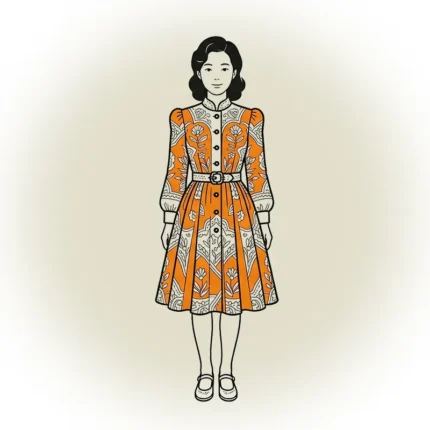
The resurgence of the 1990s country-club aesthetic and the global dominance of “Tennis Core” have elevated the Vintage Chanel Polo Dress from a nostalgic archive piece to a highly coveted investment asset. Originally designed during Karl Lagerfeld’s golden era, these dresses seamlessly merge athletic utility with elite Parisian craftsmanship.
However, the explosive demand in the secondary market has birthed a sophisticated sub-industry of high-tier counterfeits. When acquiring a vintage piece—especially one that commands thousands of dollars—relying on the seller’s assurance or mere visual aesthetics is a critical error. Authentic luxury leaves an undeniable forensic trail.
To protect your capital, you must bypass the overall silhouette and focus on the micro-details. This guide provides an industry-standard, three-step authentication blueprint focusing strictly on the hardware (buttons) and the typography (tags) of a Vintage Chanel Polo Dress.
Chanel treats its buttons not as mere functional fasteners, but as meticulously engineered pieces of jewelry. On a genuine Vintage Chanel Polo Dress, the buttons along the collar placket or faux pockets are often the most complex components to replicate.
Counterfeiters operate on margin; therefore, hardware is where they cut costs. You must evaluate the buttons through three specific lenses: weight, material integrity, and rear stamping.
Vintage Chanel buttons from the 1980s and 1990s were typically cast from heavy brass, gilded metal, poured glass (pâte de verre), or high-grade resin.
The definitive test for a vintage button lies on its reverse side. Most Chanel buttons produced during the late 80s and 90s feature specific hallmark stampings on the back.
The interior neck label is the central nervous system of luxury authentication. Chanel’s typography is proprietary, and counterfeiters utilizing standard commercial looms consistently fail to replicate the precise geometry of the Chanel logo.
When examining the main label of a Vintage Chanel Polo Dress, you must scrutinize the shape of the letters. The Chanel font is not a standard geometric sans-serif; it has distinct proportional rules.
| Letter | Authentic Vintage Characteristic | Common Counterfeit Flaw |
| C | Must form a perfect circle if closed. The ends are cut sharply and squarely. | Oval-shaped; the ends are rounded or unevenly cut. |
| H | The horizontal crossbar sits slightly higher than the exact center. | The crossbar is perfectly centered or too low. |
| E | The bottom horizontal bar is the longest, the top is slightly shorter, and the middle is the shortest. | All three horizontal bars are of equal length. |
| A | Features a flat, squared-off apex (top) rather than a sharp point. | The top comes to a sharp, aggressive point. |
Vintage labels from the 80s and 90s were typically woven onto high-quality silk or premium synthetic ribbon. The label should never be shiny, stiff, or crinkly like paper. Furthermore, Chanel secures its main labels with meticulous basting stitches at the four corners or sewn cleanly into the seam. If you see messy overlock stitching, loose monofilament (clear) threads, or any evidence of fabric glue, the garment is unequivocally counterfeit.
The final step requires locating the care and composition tag, usually sewn into the interior side seam of the dress. For a Vintage Chanel Polo Dress, this tag is a chronological map that confirms exactly when the garment was produced.
In the 1990s, Chanel standardized its dating system on the composition tags. You will find a small alphanumeric code printed on the white tag that indicates the year and the season.
If the seller claims the polo dress is a “rare 1995 vintage piece,” but the tag reads “03P” (Spring 2003), you immediately know the provenance is inaccurate.
Vintage care tags were printed using specific thermal or ink-transfer methods. Over 20 or 30 years of washing, authentic tags will show natural, even fading. However, the ink should not “bleed” into the surrounding fabric. Counterfeiters often use cheap inkjet printing that bleeds, blurs, or washes completely blank after a single dry-cleaning cycle. Additionally, ensure the translation of the materials (e.g., 100% Coton / Cotton) is spelled correctly; spelling errors on a care tag are a universal hallmark of a fake.
Acquiring a genuine Vintage Chanel Polo Dress is a brilliant sartorial investment, providing timeless elegance that transcends transient fashion cycles. However, navigating the secondary market requires the clinical precision of an archivist. By rigorously examining the density and rear stamping of the hardware, cross-referencing the proprietary geometry of the collar label, and decoding the seasonal data on the care tags, you eliminate the guesswork from your purchase. True luxury is verifiable; never settle for an imitation.

Lorem ipsum dolor sit amet, consectetur adipiscing elit, sed do eiusmod tempor incididunt ut labore et dolore magna aliqua. Ut enim ad minim veniam, quis nostrud exercitation
 EN EN
EN EN  ES
ES  FR
FR  DE EN EN ES
FR
DE
DE EN EN ES
FR
DE